Every time your heavy machinery starts up using a Direct-On-Line method, you’re essentially subjecting your infrastructure to a violent electrical and mechanical shock. You’ve likely noticed the immediate impact: flickering lights across the facility, escalating peak demand charges on your municipal bill, and the inevitable mechanical fatigue that leads to premature failure. In the demanding South African industrial landscape, relying on outdated starting methods is no longer a sustainable strategy. Implementing industrial soft starters south africa provides the precision control required to mitigate these risks whilst ensuring your operations remain resilient against grid instability.
We understand that maintaining uptime whilst managing rising electricity costs is your primary operational challenge. This article details how modern soft starters optimise motor performance and significantly extend the lifespan of your heavy equipment. You’ll gain a clear understanding of how to achieve compliance with the latest IE3 efficiency standards and municipal inrush current regulations, ultimately reducing operational downtime through superior motor protection. By transitioning to a more methodical approach to motor control, you can transform your facility into a model of industrial automation solutions in South Africa and engineering excellence.
Key Takeaways
- Understand how transitioning from Direct-On-Line starting to industrial soft starters south africa eliminates damaging inrush currents that can reach eight times the rated motor capacity.
- Learn the critical distinction between current limiting and voltage ramping to select the optimal acceleration method for your specific load characteristics.
- Discover why soft starters often represent a more cost-effective investment than Variable Speed Drives for fixed-speed applications whilst still ensuring comprehensive motor protection.
- Identify the essential factors for correct sizing in local conditions, including necessary derating for South Africa’s high altitudes and ambient temperatures.
- Explore how 40 years of local engineering expertise and Level 1 B-BBEE commitment can assist in integrating robust turnkey automation solutions into your facility.
What is an Industrial Soft Starter and Why is it Essential?
An industrial soft starter is a sophisticated solid-state device engineered to manage the acceleration of an electric motor by precisely controlling the applied voltage. Unlike traditional starters, it utilises Silicon Controlled Rectifiers (SCRs) to provide a smooth, linear transition of torque. This technology is vital for the deployment of industrial soft starters south africa, where the demand for operational precision meets the necessity of equipment longevity. By modulating the power during the startup phase, these devices ensure that the motor reaches its operational speed without the violent jolts associated with legacy methods. Understanding how a motor soft starter works is the first step in protecting your capital-intensive assets from the inherent risks of raw electrical power.
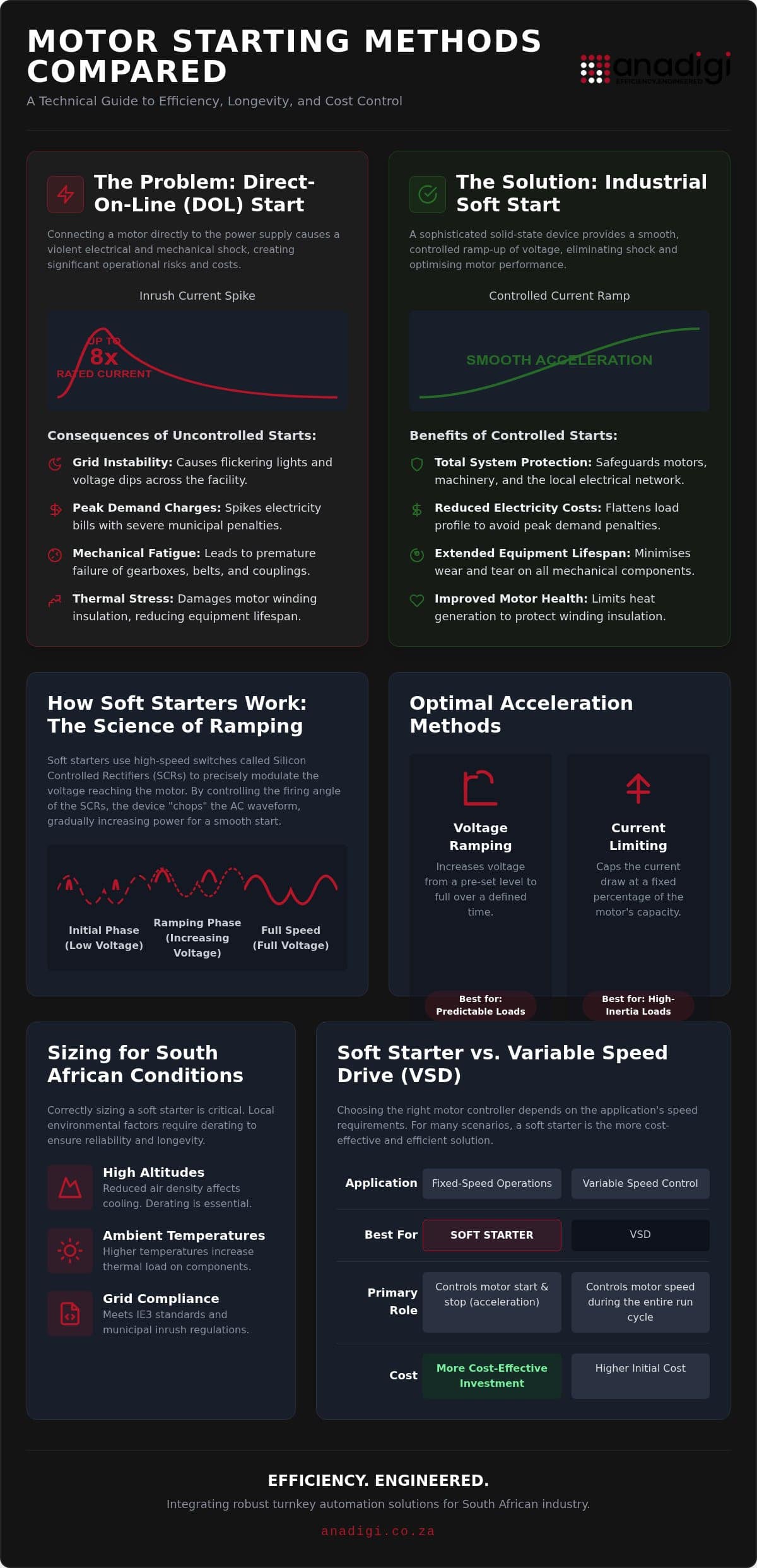
The primary challenge in heavy industry is the Direct-On-Line (DOL) starting method. When a motor is connected directly to the power supply, it draws a massive inrush current that can reach up to eight times its rated capacity. This surge creates significant thermal stress and electromagnetic interference. In the South African context, this isn’t just a technical hurdle; it’s a financial liability. Our local grid infrastructure often struggles with such sudden loads, leading to voltage dips that can disrupt sensitive electronic equipment across an entire site. By implementing a controlled start, you protect the integrity of your local network whilst safeguarding your machinery.
Reducing Mechanical Stress and Thermal Load
Soft starters play a critical role in mitigating physical damage to machinery. In pumping applications, they prevent the "water hammer" effect, which occurs when a sudden change in fluid velocity causes pressure surges that can burst pipes. For conveyor systems, the gradual application of torque reduces belt slippage and prevents excessive wear on gearboxes. Beyond the mechanical components, these devices extend the insulation life of motor windings by limiting the internal heat generated during startup. Reduced thermal load translates directly into fewer winding failures and a significantly extended motor lifespan.
Grid Compliance and Electricity Cost Reduction
Managing your utility bill requires more than just monitoring total consumption. Most South African municipalities and Eskom apply maximum demand charges based on the highest level of power drawn during a specific window. A single DOL start can spike your demand profile, leading to severe financial penalties that persist for the entire billing cycle. By using a soft starter to cap the inrush current, you maintain a flatter load profile and ensure compliance with grid regulations. A "soft start" is the controlled reduction of torque during the initial startup phase to ensure a gradual increase in motor speed and current draw. This methodical approach protects both your internal circuitry and the wider municipal network.
How Industrial Soft Starters Work: The Science of Ramping
The core of a soft starter’s operation lies in the phased-angle triggering of thyristors, also known as Silicon Controlled Rectifiers (SCRs). These components act as high-speed electronic switches that modulate the incoming AC voltage. By precisely controlling the firing angle of these thyristors, the device restricts the percentage of the electrical cycle that reaches the motor. This allows for a gradual increase in voltage rather than a sudden, full-scale surge. For those implementing industrial soft starters south africa, this mechanism is the primary defence against the electrical instability that often plagues local heavy manufacturing and mining sites.
Selecting the correct control philosophy is essential for balancing performance and protection. Most modern units offer two primary modes: voltage ramping and current limiting. Voltage ramping increases the supply from a pre-set level to full line voltage over a specific duration, which is ideal for loads with predictable friction. Conversely, current limiting caps the draw at a specific percentage of the motor’s rated capacity. This is often the preferred method for high-inertia loads or when operating on weak grids where avoiding a voltage dip is the top priority. Consulting with an expert regarding system integration services ensures these parameters are correctly calibrated for your specific site conditions.
Controlled deceleration, or "soft stop," is just as critical as the startup phase. In pumping applications, stopping a motor too quickly causes a kinetic energy rebound that results in devastating water hammer. In mining conveyor systems, an abrupt stop can lead to material pile-ups or mechanical strain on the belt. The soft starter manages this by gradually reducing the voltage, allowing the load to come to a smooth, controlled standstill. This functionality is a cornerstone of modern motor management, particularly in continuous-duty cycles found in heavy manufacturing.
Voltage Ramping and Initial Torque
To initiate movement, a motor must first overcome static friction, often called "stiction." Soft starters achieve this by applying a "pedestal voltage," which provides just enough initial torque to break the load’s inertia. Once movement begins, the ramp time is adjusted based on the application; a centrifugal fan might require a 30-second ramp, whilst a standard pump might only need 10 seconds. Once the motor reaches full operational speed, many systems utilise internal bypass contactors. This removes the SCRs from the circuit during run-time, which reduces heat and helps facilities meet international motor efficiency standards by eliminating internal switching losses.
Protection Functions and Diagnostics
Every event is recorded in a fault log, allowing your engineering team to identify patterns and implement data-driven preventative maintenance programmes. To ensure your facility has the correct diagnostic tools for these regimes, you can visit Zenith Rental to explore high-end electrical and industrial testing equipment options. This level of oversight ensures that your machinery remains operational and your maintenance budgets remain predictable.
Selecting the Correct Soft Starter for South African Conditions
Precise selection of industrial soft starters south africa requires a move away from simple kilowatt-based sizing. Whilst motor nameplates provide a nominal power rating, the actual current draw (Amps) during a heavy-duty start is the only metric that ensures long-term reliability. Sizing a starter based solely on kW can lead to underspecified hardware that fails prematurely under the stress of high-inertia loads. You must evaluate the full-load amperage and the specific torque requirements of the application to ensure the thyristors can withstand the thermal energy generated during the ramp-up phase.
Environmental variables across the South African landscape present unique challenges that standard international specifications don’t always address. In challenging high-altitude environments, common in many industrial sectors across the country, altitude plays a decisive role in hardware performance. At higher altitudes, the reduced density of the air significantly diminishes its heat-carrying capacity, necessitating a derating of the soft starter’s current capacity to prevent thermal tripping. Similarly, facilities in regions experiencing extreme ambient temperatures must account for conditions often exceeding 40 degrees Celsius, whilst operations in corrosive, saline-heavy environments require high IP ratings to protect sensitive electronics.
Integrating these devices into a broader automation framework is essential for modern operational oversight. Most high-tier soft starters now feature seamless connectivity with existing SCADA and PLC systems, allowing for remote monitoring of motor health and energy consumption patterns. Our engineering team provides comprehensive custom engineering services to ensure your hardware is perfectly matched to your site’s environmental profile and existing digital infrastructure. By conducting a thorough site assessment before installation, we ensure that your motor protection strategy is robust enough to handle local grid instability.
Duty Cycles and Start Frequency
Determining the duty cycle is a critical step in the selection process. Standard-duty applications, like centrifugal pumps, require less thermal headroom than heavy-duty applications such as stone crushers or loaded conveyors. You must also consider the start frequency; thyristors require sufficient cooling time between starts. If your process requires more than ten starts per hour, you’ll likely need to over-size the starter or implement forced-air cooling to maintain the integrity of the solid-state components.
Communication Protocols and Smart Factory Ready
Future-proofing your motor control centre involves selecting hardware that supports industry-standard communication protocols. Whether your facility utilises Modbus, Profibus, or Ethernet, ensured connectivity allows for the collection of real-time performance data. By leveraging HBox IoT applications, you can move from reactive repairs to a sophisticated preventative maintenance model. This data-driven approach ensures that your motor control strategy evolves alongside the latest advancements in industrial automation and energy management.
Turnkey Solutions: Why Partner with Ana-Digi Systems?
Established in 1985, Ana-Digi Systems has spent over 40 years refining the standard for industrial automation across Southern Africa. We don’t just supply hardware; we position ourselves as a long-term engineering partner for the nation’s most demanding industrial sectors. Our status as a Level 1 B-BBEE contributor reflects a deep-seated commitment to local economic transformation and regional excellence. When you invest in industrial soft starters south africa through our consultancy, you’re choosing a partner that understands the specific rigours of the mining and heavy industry landscapes.
Reliability is the fundamental cornerstone of our service offering. Our strategic partnership with LS Electric ensures that our clients receive world-class hardware that has been proven in the most challenging global environments. This synergy allows us to provide robust solutions that handle the grid instability and harsh environmental conditions we’ve highlighted throughout this guide. We provide a comprehensive, full-lifecycle approach. This moves from initial site assessments and custom engineering through to final commissioning with a focus on technical mastery and operational efficiency.
Local Expertise and Custom Engineering
Our engineering philosophy is grounded in methodical precision. We conduct detailed site assessments to ensure that every piece of equipment is sized correctly for its specific operational environment. This involves accounting for the altitude and temperature derating factors that are often overlooked by generalist vendors. Our engineers specialise in bespoke motor control centre (MCC) design, ensuring your new hardware integrates seamlessly with your existing automation framework. Beyond simple motor protection, our solutions are designed to help you meet modern decarbonisation and ESG goals through rigorous energy optimisation and demand-side management, which can be further enhanced by incorporating high-efficiency solar solutions from Nippon Energy.
Technical Support and Reliability
Industrial uptime is the primary pulse of your profitability. We maintain extensive local stock availability to ensure rapid response times, effectively minimising the risk of prolonged operational downtime. Our nationwide technical support for LS Electric industrial hardware means that expert assistance is always within reach of your site. We remain committed to the long-term performance of your facility, providing the stability and support you need to thrive in an increasingly competitive market. Enquire about our LS Electric soft starter range today to secure the future of your motor infrastructure with a partner you can trust.
Frequently Asked Questions
Can a soft starter be used for any type of motor?
Soft starters are designed specifically for three-phase AC induction motors, which are the workhorses of the South African industrial sector. They aren’t suitable for DC motors or most single-phase applications. If you’re operating specialised synchronous motors, you’ll need a specific engineering assessment to ensure the thyristor control logic is compatible with the motor’s excitation requirements.
How much energy does an industrial soft starter actually save?
The primary energy saving isn’t found in the motor’s running efficiency but in the reduction of peak demand charges. By capping the inrush current, you avoid the massive KVA spikes that municipal utilities use to calculate your monthly maximum demand tariff. For large motors, this can reduce the demand portion of a utility bill by a significant margin whilst also minimising thermal losses in your cabling.
What is the difference between a soft starter and a star-delta starter?
A star-delta starter is a mechanical method that switches winding connections in a single, abrupt step, which often causes a secondary current spike and mechanical jerk. A soft starter uses solid-state electronics to provide a perfectly smooth, continuous ramp from zero to full speed. It eliminates the transition shocks that lead to mechanical fatigue and electrical transients in older star-delta systems.
Is a soft starter better than a VSD for a constant speed pump?
Yes, a soft starter is typically the superior choice for applications that don’t require speed regulation once they’re running. It’s more cost-effective, has a smaller physical footprint, and doesn’t generate the continuous electrical harmonics associated with Variable Speed Drives. If your pump only needs a controlled start and stop to prevent water hammer, a soft starter provides the necessary protection at a lower capital cost.
How do I choose the right size soft starter for my application?
You must size the unit based on the motor’s Full Load Current (Amps) and the specific duty cycle of your application rather than just the kilowatt rating. When selecting industrial soft starters south africa, it’s vital to factor in the "start-stop" frequency and environmental derating for high altitudes or ambient heat. A heavy-duty crusher requires more thermal headroom than a standard centrifugal fan, even if their kW ratings are identical.
Can a soft starter help with B-BBEE and ESG compliance in South Africa?
Implementing these systems contributes to your Environmental, Social, and Governance (ESG) goals by optimising energy usage and extending the life of industrial assets. From a procurement perspective, sourcing your hardware through a Level 1 B-BBEE contributor like Ana-Digi Systems ensures your capital expenditure supports local economic transformation. It’s a dual-purpose investment that improves both technical efficiency and corporate compliance scores.
What happens if a soft starter fails during operation?
Modern units feature sophisticated diagnostics that will trigger a controlled shutdown if an internal fault or phase loss occurs. This prevents the motor from "single-phasing" or overheating, which could lead to a catastrophic burnout. Most systems include an internal or external bypass contactor, which ensures the electronics aren’t under stress once the motor is at full speed, significantly increasing the overall reliability of the installation.
Do soft starters produce electrical harmonics like VSDs do?
Soft starters only produce harmonics during the brief startup and shutdown phases when the thyristors are actively switching. Once the motor reaches full operational speed and the bypass contactor engages, the soft starter is effectively removed from the electrical circuit. This means they produce zero harmonic distortion during normal running hours, making them ideal for sites with sensitive electronic instrumentation or limited filtering capacity.