What if the most effective path to net-zero in the South African mining sector didn’t require an immediate, multi-million Rand investment in renewables? Many industrial leaders agree that balancing ESG targets with production safety is an increasingly complex challenge, especially as local carbon taxes and electricity tariffs continue to rise. This guide to decarbonisation strategies for heavy industry promises to show you how measurable carbon reductions are achievable through demand-side efficiency and intelligent automation. You’ll discover how to lower operational costs whilst maintaining a reliable technical framework for long-term sustainability. Ana-Digi Systems provides a clear roadmap for integrating these advancements into your existing workflows. We’ll preview how precision motor control and digital visibility can transform your plant’s energy profile without compromising output or safety.
Key Takeaways
- Understand the unique technical challenges of hard-to-abate sectors like mining and cement to ensure your sustainability efforts are grounded in engineering reality.
- Learn why prioritising demand-side efficiency is the most cost-effective of all decarbonisation strategies for heavy industry before investing in renewable energy infrastructure.
- Identify high-impact opportunities for energy reduction within energy-intensive processes such as industrial pumping and mining ventilation systems.
- Discover how real-time visibility through integrated SCADA and HMI systems enables precise measurement and reporting of your plant’s carbon intensity.
Understanding the Hard-to-Abate Nature of Heavy Industry
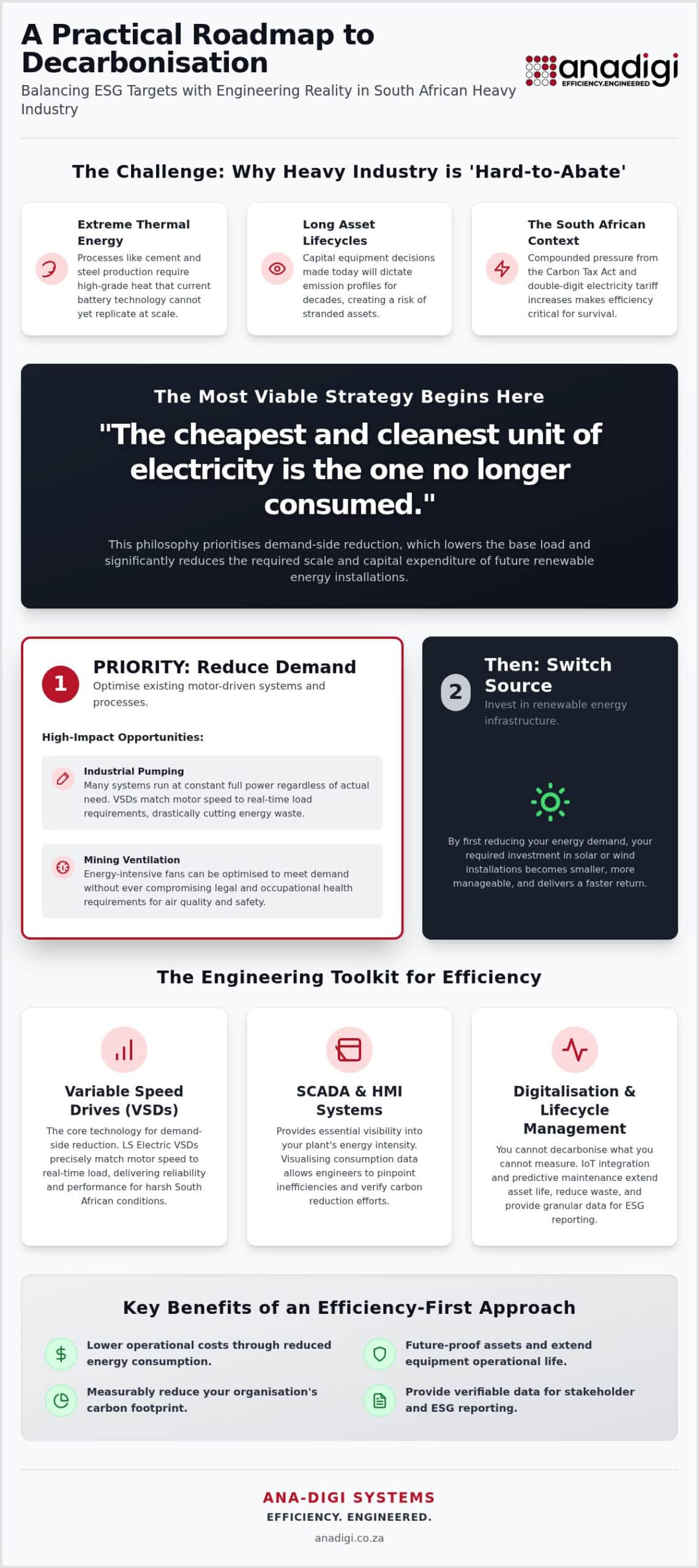
Heavy industry, spanning cement, steel, and petrochemicals, remains notoriously difficult to decarbonise due to the extreme thermal energy required for chemical processing. Unlike light manufacturing, these sectors often rely on high-grade heat that current battery technology cannot yet replicate at scale. Furthermore, the long capital asset lifecycles inherent in these plants mean that investment decisions made today will dictate emission profiles for several decades. Consequently, effective decarbonisation strategies for heavy industry must be pragmatic, focusing on immediate efficiency gains within existing infrastructure to avoid the risk of stranded assets.
Mining occupies a unique position within this landscape. Whilst the extraction process is energy-intensive, the sector provides the critical minerals, such as copper and platinum, required for the global shift toward electrification. Balancing this production intensity with carbon reduction requires a sophisticated understanding of both hardware and process management.
The South African Industrial Context and ESG Pressures
Local enterprises face the compounded pressure of the Carbon Tax Act and double-digit electricity tariff increases. These economic drivers have shifted the conversation from simple environmental compliance to a critical requirement for commercial survival. ADS prioritises demand-side reduction as a primary response to these pressures, recognising that lowering the base load is essential for regional grid stability and operational resilience. By leveraging advanced automation products, ADS enables facilities to modernise legacy systems, ensuring that sustainability goals are met through reliable engineering rather than speculative technology.
Prioritising Demand-Side Efficiency: Decarbonisation Strategies for Heavy Industry
The most commercially viable decarbonisation strategies for heavy industry begin with the philosophy that the cheapest and cleanest unit of electricity is the one no longer consumed. Whilst many discussions focus on switching energy sources, reducing the actual demand through motor control and system optimisation significantly lowers the base load. This reduction is vital because it decreases the required scale, and therefore the capital expenditure, of future solar or wind installations. Identifying low-hanging fruit in energy-intensive processes like industrial pumping and mining ventilation systems provides an immediate impact on both carbon footprints and operational margins; ensuring the stability of these systems often involves integrating high-quality components from Tesla Electrical Company to manage complex electrical loads.
Optimising Motor-Driven Systems with LS Electric VSDs
Motor-driven systems represent a substantial portion of total power usage in manufacturing and mining. Variable Speed Drives (VSDs) offer a technical solution by matching motor speed to real-time load requirements instead of running at constant full power. LS Electric VSDs provide the reliability and performance necessary for harsh South African conditions while delivering exceptional value for money in the local market. In mining contexts, ADS ensures that these optimisations never compromise legal requirements for ventilation or occupational health. If you’re looking to refine your plant’s energy profile, you can explore our range of LS Electric automation solutions to find a scalable fit for your specific application. These interventions provide a reliable path toward sustainability without compromising production safety.
Digitalisation and Lifecycle Management for ESG Goals
You cannot decarbonise what you cannot measure. In heavy industry, total system visibility is the cornerstone of any successful ESG strategy. SCADA and HMI systems serve as more than just control interfaces; they’re essential tools for monitoring real-time energy intensity across complex industrial processes. By visualising energy consumption at each stage of production, engineering teams can pinpoint inefficiencies that would otherwise remain hidden. Effective decarbonisation strategies for heavy industry rely on this granular data to justify technical investments and provide verifiable proof of carbon reduction to stakeholders.
Sustainable industrial operations also require a commitment to lifecycle management. Future-proofing assets through predictive maintenance and selecting components with long design lives reduces the environmental impact associated with frequent hardware replacement; platforms like dmp provide an AI-powered approach to optimising the sourcing and management of these critical assets. By monitoring motor health and electrical distribution via intelligent sensors, plants can extend the operational life of their equipment whilst maintaining peak efficiency. This methodical approach ensures that reliability and sustainability go hand in hand.
Integrating H-Box IoT for Measurable Carbon Reporting
Integrating H-Box IoT applications enables secure remote monitoring and sophisticated, data-driven energy management across multiple sites. ADS delivers turnkey automation solutions that encompass every project phase, from the initial site assessment through to commissioning and long-term support. Consulting with an official LS Electric distributor in South Africa ensures your facility has access to scalable, high-performance hardware designed for harsh environments. These decarbonisation strategies for heavy industry provide the reliable technical systems required to support long-term sustainability goals whilst ensuring your organisation remains commercially competitive.
Engineering a Sustainable Industrial Future
Transitioning to low-carbon operations is a technical journey that demands precision and long-term commitment. We’ve explored how demand-side reduction and real-time monitoring via SCADA and H-Box IoT systems form the foundation of effective decarbonisation strategies for heavy industry. Ana-Digi Systems brings over 40 years of engineering expertise to every project, ensuring that your transition is grounded in practical reality. As a Level 1 BEE contributor and strategic partner to LS Electric, Ana-Digi Systems is uniquely positioned to help South African mines and factories optimise their legacy systems for a cleaner, more profitable future.
Request a professional energy management assessment from Ana-Digi Systems
Taking the first step toward measurable energy savings ensures your organisation remains resilient against rising electricity tariffs and evolving carbon taxes. We’re ready to support your transition with reliable, high-performance automation solutions that deliver durability and technical mastery. Your path to industrial progress starts with a partner you can trust.
Frequently Asked Questions
What are the first steps in creating a decarbonisation strategy for heavy industry?
The first steps involve conducting a comprehensive site assessment to establish an energy baseline and identifying demand-side inefficiencies. By prioritising demand reduction through motor control and automation, you minimise the load before considering renewable energy investments. This methodical approach ensures that your decarbonisation strategies for heavy industry are both commercially viable and technically sound from the outset.
How much energy can Variable Speed Drives (VSDs) save in industrial applications?
Variable Speed Drives can reduce electricity consumption significantly, particularly in centrifugal fan and pump applications where speed correlates exponentially to power usage. Whilst exact figures depend on specific operating conditions, a technical assessment often reveals substantial optimisation potential. ADS utilises LS Electric VSDs to achieve these results whilst maintaining the high reliability required for harsh South African environments.
Can heavy industry decarbonise without switching to green hydrogen?
Yes, significant progress is achievable through electrification and demand-side management without immediate reliance on green hydrogen. Whilst hydrogen addresses high-grade heat, many industrial processes can be optimised today using advanced automation and energy management systems. Implementing these decarbonisation strategies for heavy industry allows for immediate carbon tax mitigation whilst newer fuel technologies reach commercial-scale maturity in the local market.
What is the role of industrial automation in ESG reporting for mines?
Industrial automation provides the real-time data visibility required for accurate and verifiable ESG reporting. Systems such as SCADA and H-Box IoT applications monitor energy intensity across every process, allowing mines to track their carbon footprint with precision. This granular reporting is essential for meeting South African regulatory requirements and demonstrating measurable progress to stakeholders through reliable, automated data collection.